
The food industry has navigated difficult market conditions with volatile supply and inflation pressure. As we see this ease, consumer optimism is increasing, consumers are seeking pleasure in the joy of good food. They seek valued experiences from products and brands that taste good and do good for people and planet.
This year we will explore four key mega trends shaping the future of what we eat:
Taste sensation – a desire for more meaningful experiences, consumers are seeking sensorial adventure, joy from comfort and nostalgia, spending more on premium elevation and shared experiences.
Time saving snacks – seeking products that make everyday life easy and inspirational, demand for snacks increase – small, functional products enjoyed anytime, anywhere.
Trusted sourcing – aspirational products that do good, have a clear purpose, make a positive sustainable impact, enabling you to eat sustainably, manage waste and support communities.
Naturally nutritious – a desire for clean eating, natural products providing nourishment, functional goodness and holistic wellbeing.
The poor health of our nation (driven by rising obesity) needs to be addressed. Counteracting concerns around ultra-processed foods and meeting HFSS legislative targets will be key.
There is an opportunity to support consumers to take control of their health and wellbeing, making healthy foods accessible, providing more naturally good, functional and tailored products.
Let’s explore four key health trends:
Trim and slim – Rising obesity and HFSS policy introduction is resulting in product reformulation, reducing the ‘bad stuff’ in order to manage weight and reduce illness.
Natural goodness – The UPF food debate is driving demand for clean labels, minimal ingredients and ‘real food’ ambition is driving demand for natural goodness.
Positive nutrition – Food used as medicine, providing a nutritional boost, seeking products that put the goodness in – high in protein, aiding digestion, joints, immunity.
Holistic wellbeing – Managing gender and age related concerns, along with self care, mood enhancing solutions to improve mental wellbeing, sleep, hair or skin.

Hazelnuts
The earliest mentions of hazelnuts can be found in Chinese manuscripts dating to 5000 BC. Known for their medicinal benefits, the ancient Greeks used hazelnuts to treat baldness and coughs while the ancient Romans used hazelnut branches to make torches for weddings.
Hazelnut orchards can be found all around the world but mainly in Mediterranean-type climates with Turkey being the largest growing location. The hazelnut trees, part of the birch family, can produce for more than 50 years. They are pollinated by the wind in early spring and harvest takes place in September, before they are dried to reduce the moisture for processing.
These nutritional gems are high in:
Almonds
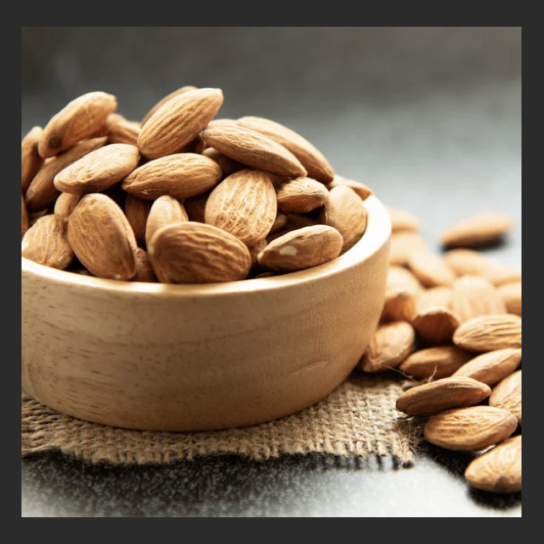
Although universally considered a nut, almonds are actually a seed. They are of historic significance too, found amongst the treasures of Tutankhamun’s tomb and a fertility symbol for the Romans. Almonds are believed to be one for the first domesticated trees with cultivated almonds appearing as far back as the Bronze Age in Jordan c.3000-2000 BC.
Today California is the largest almond producing region, benefiting from its ideal warm, dry summers and mild, wet winters. Harvested in the autumn, the outer hulls are removed and nuts are shelled ready for processing.
Almonds are full of nutritional goodness they are high in:
1. Mix the flour, salt and yeast in a large bowl, add & mix in the dried fruit and nuts. Add the water and stir everything together. The dough should be a little sticky. Keep stirring and turning the dough over until there are no dry ingredients.
2. Cover the bowl and let the dough rest at room temperature for 12 to 18 hours. The longer you leave it, the more flavour develops. After 12-18 hours, the dough will have risen and may be a shade darker than it was when you started.
3. Dust a piece of parchment paper very generously with flour. Wet your hands and fold the dough over on itself a few times to release the air inside the dough. Shape the dough into a round and place it on the floured parchment paper, seam side down.
4. Dust more flour on the top of the dough and cover the dough by inverting the mixing bowl over the top. Let the dough rest like this for up to 2 hours. After the dough has rested for 1 to 1 ½ hours, place a lidded cast iron casserole dish into your oven and pre-heat the oven to 220ºC, 200ºC Fan for 30 minutes. Then, working carefully, remove the casserole dish from the oven and take off the lid. Make three slashes in the top of the bread using a serrated knife. Use the parchment paper to lift the shaped dough into the pot, paper and all, and cover with the lid. Return the pot to the oven for 30 minutes.
5. After 30 minutes, remove the lid and let the bread continue to bake until it is nicely browned on top – about 10 to 15 minutes. Remove the pot from the oven and let the bread sit in it for about 5 minutes. Then, transfer to a cooling rack to cool for 30 minutes before enjoying.
5 minutes (rise time 14-20 hours, cook time 40 minutes)
420g strong flour
140g wholewheat flour
7g instant dried yeast
12g salt
20g raisins, sultanas or currants
50g soft dried cranberries
65g roasted hazelnut halves
54g almond slivers
415g water
Registered in England no: 02084187.
Registered Office: Pudding Lane, Spalding,
Lincolnshire, PE11 3TJ, UK


J.O. Sims Ltd All Rights Reserved. Website Designed by MacMartin.
| Cookie | Duration | Description |
|---|---|---|
| cookielawinfo-checkbox-analytics | 11 months | This cookie is set by GDPR Cookie Consent plugin. The cookie is used to store the user consent for the cookies in the category "Analytics". |
| cookielawinfo-checkbox-functional | 11 months | The cookie is set by GDPR cookie consent to record the user consent for the cookies in the category "Functional". |
| cookielawinfo-checkbox-necessary | 11 months | This cookie is set by GDPR Cookie Consent plugin. The cookies is used to store the user consent for the cookies in the category "Necessary". |
| cookielawinfo-checkbox-others | 11 months | This cookie is set by GDPR Cookie Consent plugin. The cookie is used to store the user consent for the cookies in the category "Other. |
| cookielawinfo-checkbox-performance | 11 months | This cookie is set by GDPR Cookie Consent plugin. The cookie is used to store the user consent for the cookies in the category "Performance". |
| viewed_cookie_policy | 11 months | The cookie is set by the GDPR Cookie Consent plugin and is used to store whether or not user has consented to the use of cookies. It does not store any personal data. |